"This contest of men with padded gloves on their hands… is no superficial thing, a fad of a moment or a generation… It is as deep as our consciousness, and it is woven into the fibers of our being. It grew as our very language grew. This is the ape and tiger in us, granted. We can’t get away from it. It is the fact… We like fighting — it’s our nature."
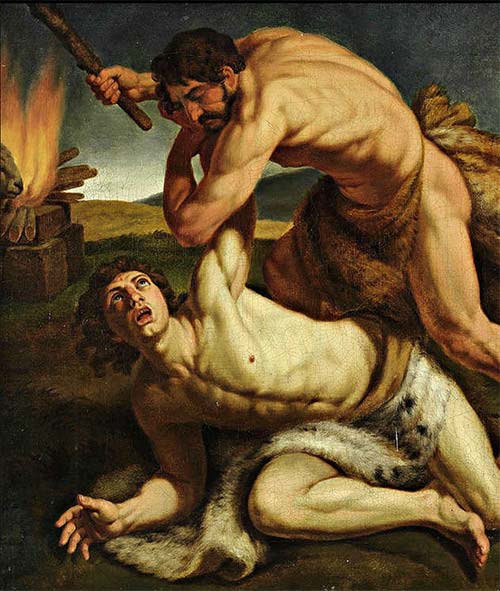
Cain Killing Abel, Oil – French, Anonymous (19th Cent)
As Adam raged against temptation in The Garden, as Cain slew Abel, as David faced Goliath, as heroes of The Iliad brutally sparred, as “The Big Smoke” Jack Johnson met “Great White Hope” Jim Jeffries in 1910 over color and crown, humankind has always been filled with a desire so hot it must be battled over.
We yearn. We burn. We toss and turn. We want, so we war.
Desire: why we fight.
In other words, we’ve always been raising fists at one another. Perhaps that is because it is in our nature.
19th century American essayist, Ralph Waldo Emerson wrote, “Man was made for conflict, not for rest. In action is his power, not in his goals but in his transitions man is great.” From its inception America has remained a nation ripe with transition.
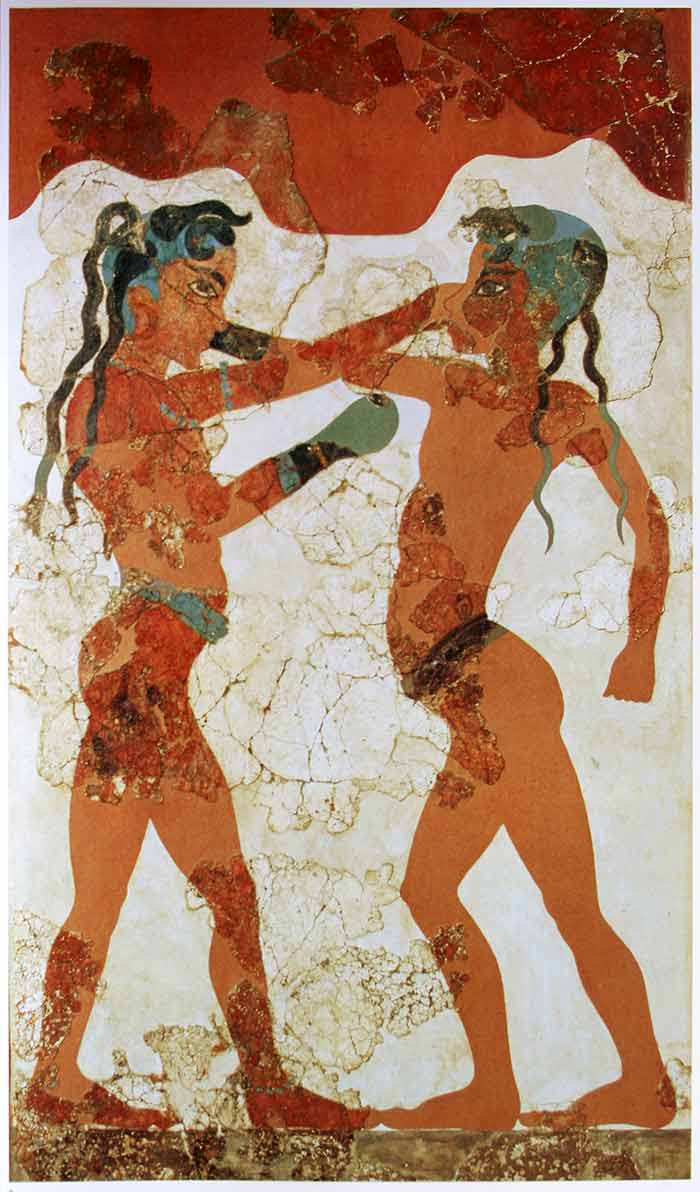
Young Boxers, Fresco – Akrotiri, Greece (1700 BCE)
America — a nation of immigrants, first people, and old money, dreamers, makers, takers, and breakers, human beings seeking second chances in the Promised Land. The tired, the poor, the huddled masses yearning to breathe free. Indian tribes, bluntly battered to the brink of extinction. The black man, freed from slavery, but relentlessly hunted, haunted, and pummeled by a renaissance of racial fury. The Irishman, mocked, tromped, and starved in America, just as he was on the famine plagued island he fled for better days.
Every man had his dream, so every man had his fight.
“The history of the ring is the story of young men squaring up to (what they’re told they can never have), some paying the ultimate price for a burning desire to escape their surroundings,” writes Michael Prestage in Celtic Fists. “In the main, those who box chose to do so because they have a stark choice – it’s boxing or the coal mines.”
David Slays Goliath, Daniele da Volterra – circa 1550 (au Louvre)
The math was simple: an immigrant and his sons might earn a dollar a week in the mines, railroads, or lumber yard.
Or he could win a hundred of dollars in a single, hour-long boxing contest.
By the 1920s, the heavyweight boxing championship of the world was worth more than $250,000 (or nearly $3.7-million, adjusted) to a man.
“Any fighter, champion or not,” writes the late, legendary sports journalist John Lardner, “enjoys a special kind of power and prestige.”
Ah yes! Boxing: how a man could change his stars.
In “Why We Fight, Part 2,” we’ll look at how Boxing reflected and organized the chaos of the early 20th Century.
Contains information related to marketing campaigns of the user. These are shared with Google AdWords / Google Ads when the Google Ads and Google Analytics accounts are linked together.
90 days
__utma
ID used to identify users and sessions
2 years after last activity
__utmt
Used to monitor number of Google Analytics server requests
10 minutes
__utmb
Used to distinguish new sessions and visits. This cookie is set when the GA.js javascript library is loaded and there is no existing __utmb cookie. The cookie is updated every time data is sent to the Google Analytics server.
30 minutes after last activity
__utmc
Used only with old Urchin versions of Google Analytics and not with GA.js. Was used to distinguish between new sessions and visits at the end of a session.
End of session (browser)
__utmz
Contains information about the traffic source or campaign that directed user to the website. The cookie is set when the GA.js javascript is loaded and updated when data is sent to the Google Anaytics server
6 months after last activity
__utmv
Contains custom information set by the web developer via the _setCustomVar method in Google Analytics. This cookie is updated every time new data is sent to the Google Analytics server.
2 years after last activity
__utmx
Used to determine whether a user is included in an A / B or Multivariate test.
18 months
_ga
ID used to identify users
2 years
_gali
Used by Google Analytics to determine which links on a page are being clicked
30 seconds
_ga_
ID used to identify users
2 years
_gid
ID used to identify users for 24 hours after last activity
24 hours
_gat
Used to monitor number of Google Analytics server requests when using Google Tag Manager