

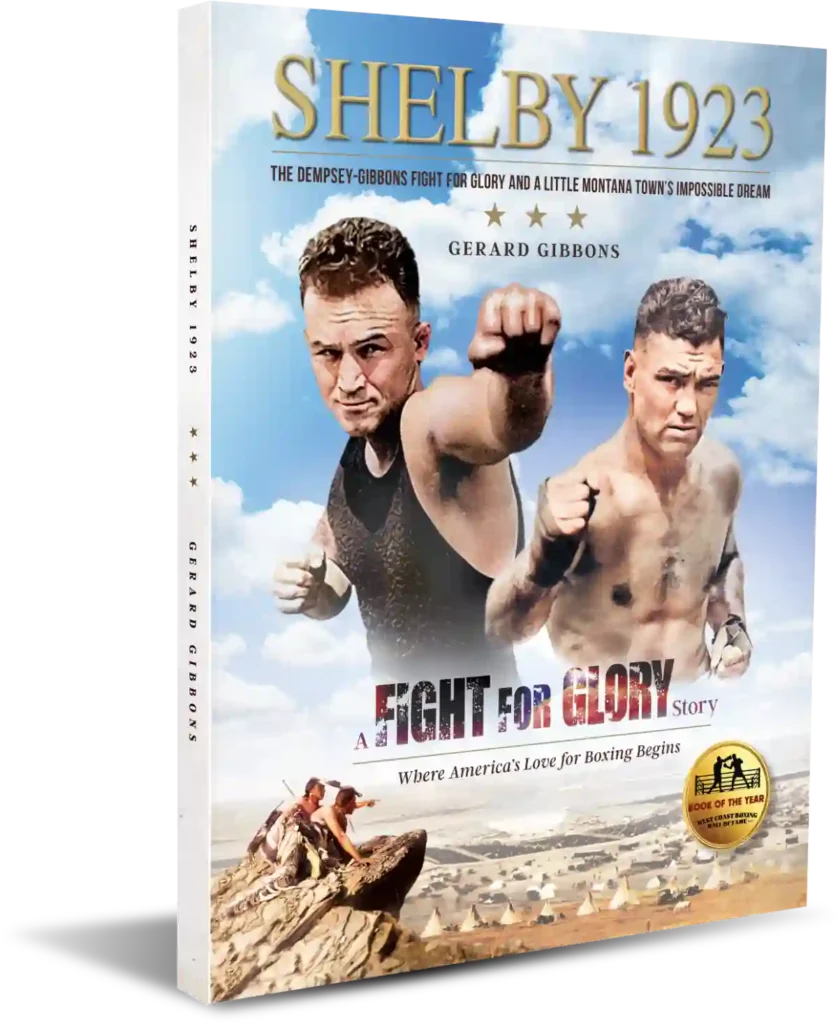
SHELBY 1923
The Dempsey-Gibbons Fight for Glory and a Little Montana Town’s Impossible Dream
By DR. GERARD GIBBONS
Author • Historian • Descendant
Book Club & Reading Group Discussion Guide

Dear fellow Readers,
Thank you for choosing SHELBY 1923 as your book club selection. I am honored that you did so, and hope that you enjoyed the story. Please keep in mind that more installments to the Fight for Glory literary series are coming soon. This is an authentic American epic story that spans one-hundred years.
I grew up hearing about the story of SHELBY 1923 from my father, Tommy Gibbons Jr., who at six-years old, was seated ringside with legendary Blackfeet Chief Curly Bear for the storied heavyweight championship fight between his father and Jack Dempsey. It is a thrill to be able to share this unforgettable American sports spectacle with you!
Taking on the mission of uncovering my family story was a major undertaking. It was not my life plan until it suddenly was. This is revealed in the author Q&A at the end of the book THE ST. PAUL PHANTOM: The Gibbons Brothers’ Fight for Glory, Volume I. The journey was much harder than I ever imagined. Yet, it was also more rewarding, revealing, and relevant than I could have dreamed of. I’d suggest that when you’re ready to know yourself, you consider uncovering your family legacy. Everyone has one. We owe it to ourselves and others, to know it and pass it on. It may be all we have to leave behind.
Keep the faith! With blessings and gratitude,
Gerard
HOW TO USE THIS GUIDE
This discussion guide is designed for book clubs, libraries, classrooms, and community reading programs. Questions are organized by major sections of the book and focus on character, theme, symbolism, historical context, ethics, and emotional impact. Groups are encouraged to select questions that best suit their time, interests, and familiarity with boxing history.
BOOK OVERVIEW
An Impossible Dream. A Million-Dollar Prizefight. A Battle of Life and Death in the Middle of Nowhere. In the roaring Jazz Age, always-smiling underdog boxing maestro Tommy “The Happy Warrior” Gibbons races against time to claim the heavyweight crown and save his beloved wife from debilitating mental illness. Standing in his way: savage champion Jack Dempsey and his villainous manager Jack Kearns—“The Beelzebub of Boxing.” Tommy’s quest leads him to tiny Shelby, Montana—“the little town that God forgot”—a desperate Wild West outpost betting everything on one epic showdown. Filled with con artists, cowboys, Blackfeet warriors, bootleggers, and movie stars, this exhaustively researched and lushly illustrated saga explodes with heart-pounding actions, star-crossed romance, and unbreakable spirit.
MAJOR THEMES TO CONSIDER
- Impossible dreams and American ambition
- Small towns versus national power
- Honor, risk, and moral compromise
- Memory, legacy, and storytelling
- Media, spectacle, and mythmaking
- Unlikely friendships, enduring bonds and relationships
- Faith, family, love, and quiet sacrifice
OPENING & AUTHOR’S NOTE
- How does the author’s personal connection to Tommy Gibbons shape your trust in the story?
- What role do memory and inheritance play in motivating the author’s search for truth?
- How does the framing of this story as a “true-good” tale affect your expectations as a reader?
PART I: THE DREAM OF SHELBY (Chs. 1–5)
- Body Johnson believes survival itself makes him lucky. How does this belief shape his willingness to take risks
- Shelby is described almost as a living character. What qualities define the town in its early chapters?
- How do women and family relationships quietly influence decisions during Shelby’s rise?
- At this stage, does the dream of Shelby feel inspiring, reckless, or both?
PART II: BUILDING THE SPECTACLE (Chs. 6–10)
- Contracts, publicity, and promises drive the story forward. Which agreements feel most fragile or dangerous
- How does media attention begin to distort reality for Shelby and its leaders
- Jack Dempsey is powerful but distant. How does anticipation shape his role before he ever enters the ring?
- Where do you begin to sense that the dream may be slipping out of control?
PART III: PRESSURE & CONSEQUENCES (Chs. 11–15)
- What does the book suggest is the difference between hope and denial
- How do natural disasters and illness mirror emotional and financial strain?
- Who bears the greatest unseen costs as Shelby pushes forward?
- How does the bond between the Blackfeet Chief and the Tribe and Tommy Gibbons deepen your interest in the story?
- Why is the idea of a “death watch” such a powerful metaphor at this point in the story?
PART IV: TRUTH & RECKONING (Chs. 16–18)
- When uncomfortable truths surface, do they clarify the situation or complicate it further
- How does Tommy Gibbons redefine what it means to be a champion
- In what ways does honor matter more than victory for certain characters?
PART V: COUNTDOWN & CONFRONTATION (Chs. 19– 22)
- Why does the language of war reappear as the fight approaches?
- How does time itself become a source of tension and conflict
- During the fight, what moments felt most human rather than spectacular?
- Is the bout portrayed as a culmination—or a turning point?
PART VI: EVERYTHING AFTER (Ch. 23 & Epilogue)
- How does the book define success after the spectacle has ended
- What consequences linger longest for the town of Shelby
- How do photographs, artifacts, and archival materials deepen the emotional impact of the ending?
FINAL REFLECTION QUESTIONS
- What does Shelby 1923 suggest about the cost of chasing national attention
- Which character changed the most in your eyes over the course of the book?
- How does this story resonate with modern ideas of ambition, media hype, and community identity?
- In what ways is this book ultimately about love rather than boxing?
- Did Tommy Gibbons value dignity and character more than victory going into the fight
- Was Shelby’s gamble heroic, reckless, or simply inevitable
- How might the story have unfolded differently if the fight had taken place in a major city
- Do modern sports still allow room for moral victory?
- How does Helen’s perspective reshape the reader’s understanding of the fight
- Is Jack Dempsey portrayed as a villain, or as a product of his era?
- How does history decide which figures are remembered as heroes
- Why do underdog stories without clear victory remain so powerful
- What role does community memory play in shaping legacy?
- What does SHELBY 1923 suggest about how success is defined in American culture?
OPTIONAL GROUP ACTIVITIES
- Locate Shelby, Montana on a map and discuss how geography shaped its fate.
- Compare media hype in the 1920s to modern sports or entertainment spectacles.
- Share a personal or local story where ambition transformed a community—for better or worse.
LITERARY CRAFT AND VISUAL STORYTELLING
- How would you describe the book’s style: cinematic, lyrical, journalistic, novelistic, documentary, or some blend?
- What is the effect of the poetic and allusive chapter titles?
- Which chapter title acquires the greatest additional meaning after the chapter has been read?
- How does the author create suspense when readers may already know the historical outcomes?
- How do archival photographs and illustrations affect your sense of intimacy, credibility, and time?
- Did the images make the historical figures feel more knowable, or did they emphasize how much remains unknowable?
- How does the large Historical Cast contribute to the book’s sense of scope?
- Do the fight scenes remain accessible to readers unfamiliar with boxing?
- Which writing choices make the boxing sequence vivid?
- Where does the author slow the narrative for emotional reflection?
- Where does he accelerate it?
- How does the book move between private family life and large public events?
- How does the first-person family frame alter the tone of the larger third-person historical narrative?
- Where does the book appear most influenced by oral history or inherited family storytelling?
- Which scene would translate most effectively to film?
PLEASE HELP SPREAD THE WORD ABOUT A TRUE GOOD STORY
Ways Your Book Club Can Help Bring This Forgotten American Story Back to Life
Dear Readers,
If SHELBY 1923 sparked a great conversation in your book club or reading group, I’d be honored if you’d help keep that conversation going. Choose one, choose five, or do them all—every review, recommendation, photo, post, and introduction helps another reader discover Mike and Tommy Gibbons and their remarkable TRUE GOOD story.
With Gratitude and great respect,
Gerard
-
- Leave an honest book review.
I invite you, or each member—not just the club organizer—to leave a brief, honest review of SHELBY 1923, on Amazon, Goodreads, StoryGraph, Barnes & Noble, or wherever they discuss books. Even two or three sentences is valuable. - Chronicle your “SHELBY Book Club” experience on social media.
Take a photo with your book or encourage photos of your club members posing with their books. Tag the book/author and use a distinctive hashtag such as #SHELBY1923, #FightForGloryStory, or #SHELBYBookClub #Gibbonsbrothers. - Create a 30–60-second “Why You Should Read SHELBY 1923” video.
Record a simple phone video: “I just finished SHELBY 1923, and here’s why I think you should read it…” Consider sharing why you think the book is well suited as an America250 theme story. Tag you and the book and give permission to repost. - Tell me YOUR Story.
Because SHELBY 1923, is about family, faith, love, brotherhood, ambition, adversity, resilience, history, community, unlikely friendships, and forgotten lives, I invite you to share what the book reminded you about your own family and your connection to history.- “Tommy reminded me of my grandfather and his brother…”
- “My family came to the U.S. through St. Paul (or New York, or x) at the same time…”
- “My grandfather worked for the railroad…”
- “My family member boxed in the army during the war…”
- “My mother met my father in a similar circumstance…”
- “My family also had a special relationship with Native Americans…”
- “Reminds me of stories of my ancestors making their way in the American West…”
- “My father boxed at the YMCA…”
- “I didn’t expect to find boxing interesting…”
- “I was drawn to the story for (w, x) reasons, but I was surprise to find (y, z) more interesting than expected…”
- Recommend the SHELBY 1923 to your local library, local-history center, or another book club.
Ask members to submit a purchase/request form to their public library. Or suggest SHELBY 1923 for the library’s own reading group, local-history programming, or another book club. - Recommend the SHELBY 1923 to a local independent bookstore.
If you or your members enjoyed SHELBY 1923, please tell your favorite bookseller about it—particularly stores that host nonfiction, history, sports, biography, Irish-American, or regional-history events. A recommendation coming from an actual customer carries a different kind of credibility than an author’s cold pitch. - Invite Gerard to your club.
“Bring the Author to Your Book Club.” You may wish to consider inviting me through the CONTACT link to a virtual 20–30-minute visit/Q&A with your book club. I’d love to consider joining for a virtual appearances if my schedule allows.
Fight the good fight!
Gerard
DR. GERARD GIBBONS
Author • Historian • Descendant - Leave an honest book review.