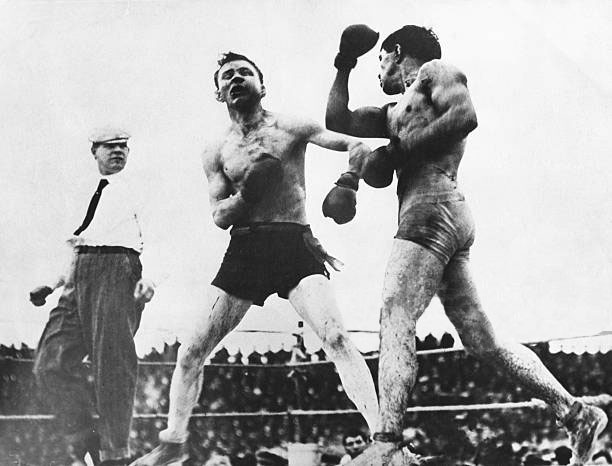
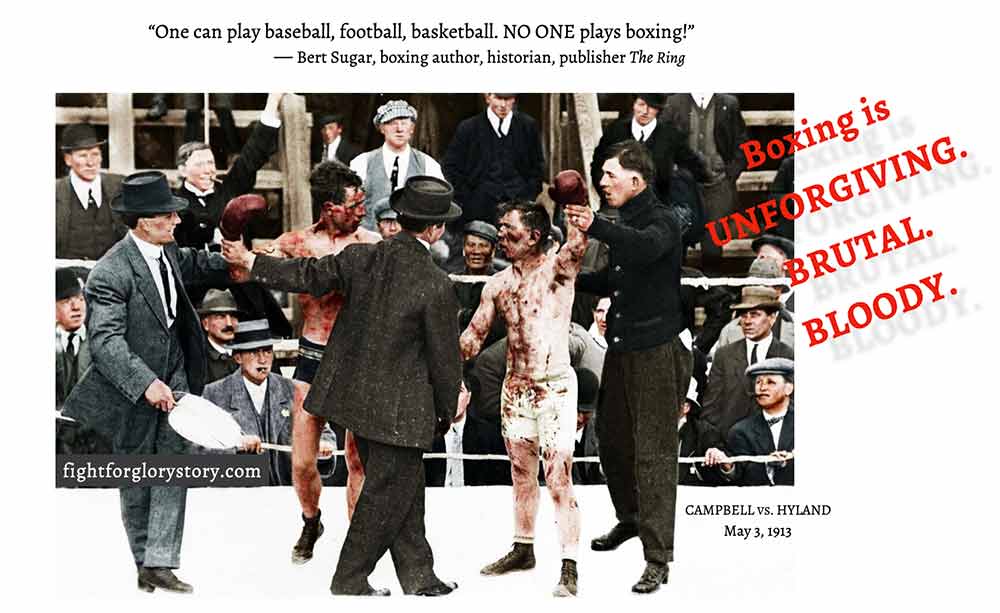
"One plays baseball, football, basketball. NO ONE plays boxing."
Boxing Blow to the Chin
“When an underprivileged boxer succeeds against overwhelming odds and insurmountable obstacles, at enormous personal costs, the hopes of all Americans are buoyed,” writes Jeffrey T. Sammons in Beyond the Ring.
“In this role, boxers become integral elements in a belief system that thrives on the willingness of an overwhelming majority of its faithful to dream the impossible – that success is there for the striving.”
Sammons continues: “(Boxing heroes are) the embodiment of the American Dream, in which the lowliest of individuals rise to the top by their own initiative and perseverance. The elusiveness of that dream is immaterial. The meaning of the dream is in its acceptance — not its fulfillment.”
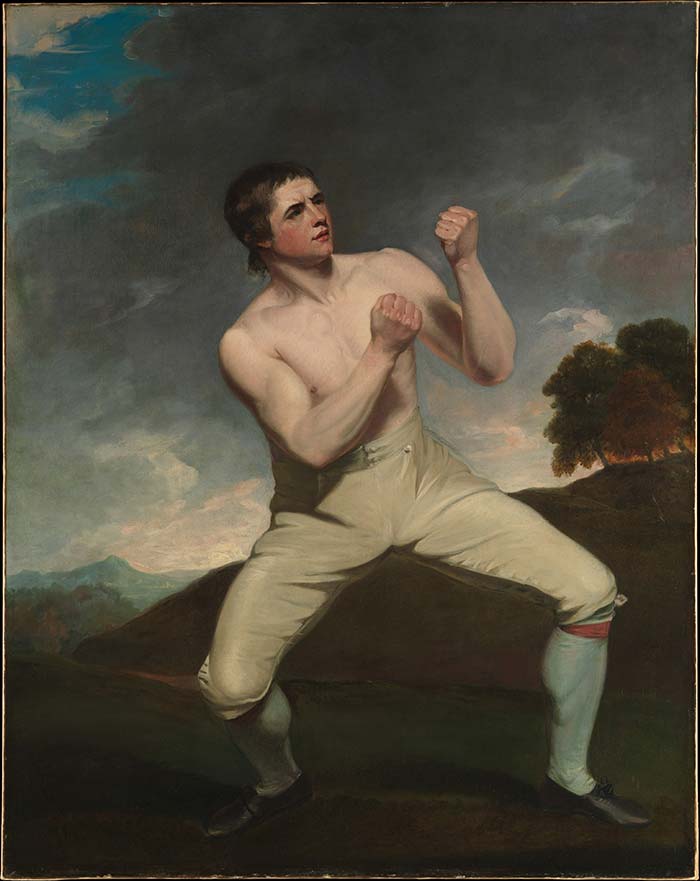
The Boxer, Richard Humphreys – c. 1788
In America, however, early boxing was illegal in most states and territories, an underground athletic contest for the underclass, a peoples’ sport played out in the woods, on barges, in barns and saloons, out of polite society’s line of vision.
Getting caught could cost a man a thousand-bucks and a year in jail.
“From its earliest appearance in America,” writes Sammons, “prizefighting was a taboo sport.”
For a time, they called boxing The Devil’s Opera.
Boxing is insurgence. It is rebellion. It is the distillation of the whole wide world’s chaos into two corners, a squared circle, cordoned by ropes, governed by a rule book, with only a hero or a villain to cheer or hiss.
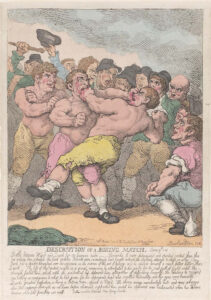
1812 – Boxing Match, Ward vs. Quirk etching, Met. Museum of Art, NY
“Boxing did not just reflect the bloodiness of life. Rather it helped shape violence into art, bringing order and meaning,” Prestage writes in Celtic Fists. “At its best, the ring rendered mayhem rule-bound instead of anarchic, voluntary rather than random… It taught men to face danger with courage, to be impervious to pain, and to return violence rather than to passively accept it.
”We fight over women, over insult and folly, over property, skin color, and turf, over nothing more than being told you will never have what you want.
“Hope on, hope ever – that is (the boxer’s) slogan,” writes British sportswriter Trevor C. Wignall. “It is the hope that springs eternal that keeps them steadfast to an occupation that is cruelty personified.”
Except when it does not. Sometimes, no matter how mannered the battle, the outcome is savage, as anyone who knows anything about pugilism will concede.
If any sport has made hymn of luck, it is boxing, the good luck prevailing only when the gods decide it weaves a better tale.
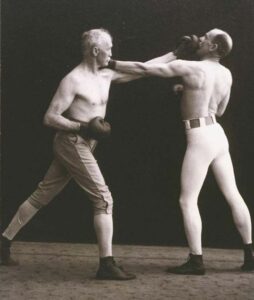
Professor Mike Donovan (left) Instructs Boxing – c.1910
Boxing, it is said and is widely known, will break your heart. Sometimes you win. Sometimes you lose. Sometimes when you win, you’re actually losing. Not often, but sometimes, when we lose, we’re just beginning to win.
One day you’re a hardworking, God-fearing, fiercely nationalistic Irishman who can neither overthrow your British oppressors nor pay your rent.
The next day, you’re a land-owning tradesman, well loved by family and community, living comfortably, bountifully, gratefully in a brand new world.
One day you’re a pauper, a misfit, an orphan, a fool or a bastard. The next day, a hero. A god among men.
One day, you’re a nobody from the middle of nowhere. The next day, you’re champion of the world.
Family, faith, freedom, and glory — this is why Mike and Tommy Gibbons fight.
Contains information related to marketing campaigns of the user. These are shared with Google AdWords / Google Ads when the Google Ads and Google Analytics accounts are linked together.
90 days
__utma
ID used to identify users and sessions
2 years after last activity
__utmt
Used to monitor number of Google Analytics server requests
10 minutes
__utmb
Used to distinguish new sessions and visits. This cookie is set when the GA.js javascript library is loaded and there is no existing __utmb cookie. The cookie is updated every time data is sent to the Google Analytics server.
30 minutes after last activity
__utmc
Used only with old Urchin versions of Google Analytics and not with GA.js. Was used to distinguish between new sessions and visits at the end of a session.
End of session (browser)
__utmz
Contains information about the traffic source or campaign that directed user to the website. The cookie is set when the GA.js javascript is loaded and updated when data is sent to the Google Anaytics server
6 months after last activity
__utmv
Contains custom information set by the web developer via the _setCustomVar method in Google Analytics. This cookie is updated every time new data is sent to the Google Analytics server.
2 years after last activity
__utmx
Used to determine whether a user is included in an A / B or Multivariate test.
18 months
_ga
ID used to identify users
2 years
_gali
Used by Google Analytics to determine which links on a page are being clicked
30 seconds
_ga_
ID used to identify users
2 years
_gid
ID used to identify users for 24 hours after last activity
24 hours
_gat
Used to monitor number of Google Analytics server requests when using Google Tag Manager