

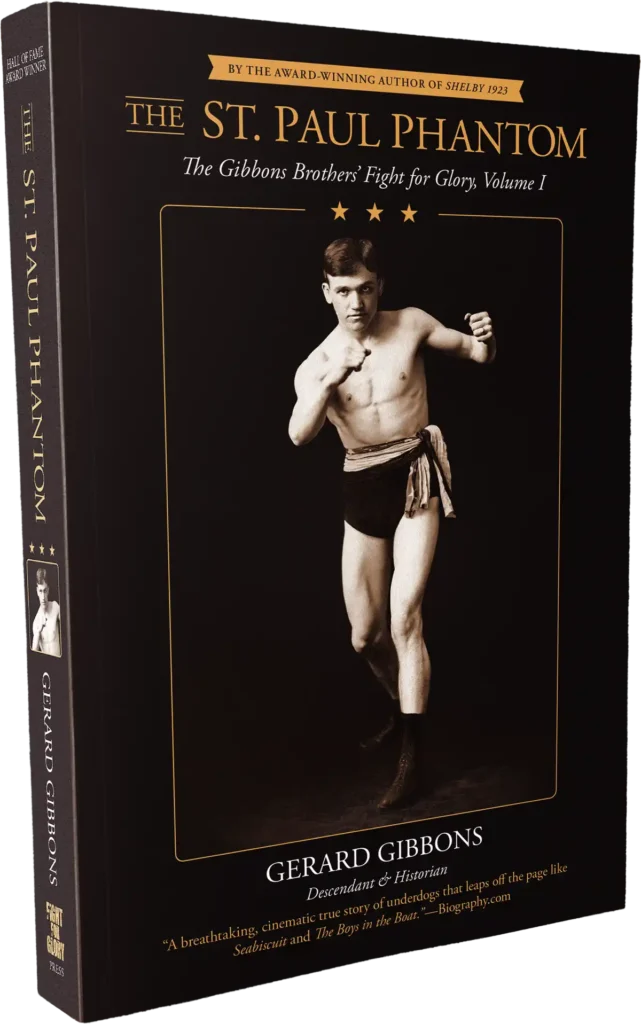
The St. Paul Phantom
The Gibbons Brothers’ Fight For Glory, Volume I
By DR. GERARD GIBBONS
Author • Historian • Descendant
Book Club & Reading Group Discussion Guide

Dear fellow Readers!
Thank you for choosing THE ST. PAUL PHANTOM: The Gibbons Brothers’ Fight for Glory, Volume I as your book club selection. I am honored that you did so, and hope that you enjoyed the story. Please keep in mind that more installments to the Fight for Glory literary series are coming soon. This is an authentic American epic story that spans one-hundred years.
Taking on the mission of uncovering my family story was a major undertaking. It was not my life plan until it suddenly was. This is revealed in the author Q&A at the end of the book. The journey was much harder than I ever imagined. Yet, it was also more rewarding, revealing, and relevant than I could have dreamed of. I’d suggest that when you’re ready to know yourself, you consider uncovering your family legacy. Everyone has one. We owe it to ourselves and others, to know it and pass it on. It may be all we have to leave behind.
Keep the faith! With blessings and gratitude,
Gerard
HOW TO USE THIS GUIDE
This discussion guide is designed for book clubs, libraries, classrooms, historical societies, boxing organizations, and community-reading programs. It is intended to make discussion lively, inclusive, and easy to lead—even when some participants know little or nothing about boxing. The questions move from accessible personal reactions to deeper consideration of character, history, ethics, literary craft, visual storytelling, and symbolism. Hosts should select the questions that best suit their group rather than attempting to cover every question.
BOOK OVERVIEW
The St. Paul Phantom follows legendary boxing brothers Mike and Tommy Gibbons from hardship and neighborhood struggle in St. Paul into the glamour, turbulence, violence, politics, and myth-making of boxing’s Golden Age. As the twentieth century roars to life, everyone has a dream, so everyone has a fight.
At the center of the story is Mike Gibbons—the elusive “St. Paul Phantom,” a master of scientific boxing whose intelligence, timing, strategy, and grace challenged the era’s worship of brute force. Around him unfolds a larger American story of family, immigration, faith, race, class, ambition, romance, world war, pandemic, celebrity, and the uneasy cost of public success.
More than a boxing biography, The St. Paul Phantom is a sweeping family saga and work of narrative history about the ways people fight—for recognition, for respect, for dignity, for survival, for love, and for a lasting place in the stories their country tells about itself.
MAJOR THEMES TO CONSIDER
- Brotherhood, rivalry, loyalty, and inherited responsibility
- The American Dream—and the people who benefit, are excluded from, or damaged by it
- Brains versus brawn
- Craft, discipline, respect, restraint, humility, exposure to danger and relevance to “scientific” boxing
- Immigrant identity and Irish-American ascent, and relatedness of any ethnic group
- Class, neighborhood, and social mobility
- Race, unequal opportunity, the color line, and the moral contradictions of early boxing
- Masculinity, tenderness, marriage, and family duty
- Fame, media, spectacle, and public mythmaking
- The creation of heroes, villains, and legends
- Faith, ritual, luck, and destiny
- World war, patriotism, selfless service, honor and sacrifice
- The 1918 influenza pandemic, collective trauma, and the responsibility of leadership to speak truth
- Grief, survival, and emotional restraint
- Memory, archives, family storytelling, and historical truth
- The difference between winning a fight, and becoming a champion, crowned or uncrowned.
WHOLE-BOOK QUESTIONS
- The book opens with Theodore Roosevelt’s image of the “Man in the Arena.” How does this ideal shape the book’s understanding of risk taking, courage, failure, criticism, humility, and achievement?
- Is Mike Gibbons’ greatest gift his physical skill, his intelligence, his temperament, his discipline, or his ability to read other people? What evidence supports your view?
- How does Tommy function as Mike’s brother, protégé, rival, mirror, and eventual bearer of the family legacy?
- In what ways is St. Paul more than a setting? How does the city shape the brothers’ identities, ambitions, loyalties, values, and limitations?
- What does the book reveal about the relationship between sports and the larger forces of the era, including immigration, race, reform, labor, religion, war, employment opportunity, and mass media?
- Which supporting character most changed or deepened your understanding of Mike and Tommy?
- Does the book ultimately celebrate the American Dream, validate it, mourn it, criticize it, or redefine it?
- How does Gerard Gibbons’ family connection affect your trust in and emotional response to the narrative?
- By the end of the book, what does the story suggest a true champion is?
PART I: BRING BACK THE GOOD OLD DAYS (1850–1911)
Opening, Introduction, and Historical Cast
- How does the author’s childhood memory of Tommy Gibbons establish the emotional stakes of the book?
- What advantages come with writing history from inside one’s own family?
- How do the Historical Cast pages affect your expectations before the principal narrative begins? How does the Cast and archival images influence your initial sense of credibility and historical immersion?
- Why might the author begin with his personal memory before moving into documented history?
- The author quotes filmmaker Ken Burns, stating that the historian’s task is to “wake the dead” and that “God is in the details”. In what ways does the meticulous archival detail (letters, photos, illustrations, memorabilia, fight records, newspaper accounts) make the early 20th century feel deeply personal?
Chapter 1: “The Comet Vow”
- Why is Halley’s Comet an effective image for the brothers’ shared vow? Does the vow feel like youthful fantasy, destiny, a survival strategy, or some combination? How does the comet establish the book’s interest in fate, recurrence, memory, historical events, and the passage of time?
- What does the scene reveal about the relationship (emotional, fraternal, or otherwise) between Mike and Tommy?
- Why do children and young people sometimes need grand promises, lofty ambitions, or myths to endure difficult circumstances?
Chapters 2–5: “Frogtown Hustle,” “Fall from Grace,” “Exodus,” and “Trouble”
- How do poverty, neighborhood culture, religion, and family tension shape the brothers before boxing itself does? How does the Frogtown environment encourage resourcefulness, toughness, performance, or deception?
- Which early hardship appears most formative for Mike?
- Chapter 4 (“Exodus”) reveals Thomas John Gibbons’ harrowing past in County Mayo during the aftermath of the Potato Famine and his history as an “Invincible” rebel against English rule. How does Thomas John’s secret history explain his intense aversion to violence and prizefighting for his sons?
- How does migration alter the family’s sense of identity and belonging? What is lost when a family leaves one home in search of another? Which early event seems to plant the strongest seed of Mike’s later determination for self-reliance and self-control?
- In Chapter 3 an underground rooftop fight refereed by young George Barton that turns near-fatal for Kid Braun. How does the tragedy highlight physical, emotional, legal risks of boxing during its outlaw era?
- Comment on the Muscular Christianity movement, both as it serves the narrative, but also in real life? What might Muscular Christianity or the Physical Culture movement mean in today’s world?
- Father John Dunphy defends self-defense to Thomas John, arguing that God made man “equal parts animal and angel”. What did you think of Father Dunphy’s philosophy of “Muscular Christianity”? Is his moral stance justified?
Chap 6–9: “Glorious Little Fella,” “Silver Dollar Baby,” “Fire with Fire,” and “The Handcuff King”
- How does the narrative balance childhood innocence with dreams, danger, money, labor, performance?
- What does the idea of escape—literal or symbolic—mean in these chapters? How does the fascination with Harry Houdini and escape artistry connect with Mike’s developing identity?
- What does the “silver dollar” symbolize within the family’s economic and emotional world?
- Mae Walsh is portrayed as an independent, forward-thinking woman involved in suffrage marches and social activism. How does her relationship with Mike challenge early 20th-century gender norms? Why does she demand Mike “come home handsome”?
- When is fighting presented as self-defense, and when does it become performance or opportunity?
- In Chapter 9, Mike faces his childhood bully Herb Catherwood and later ends up arrested and jailed. How does his father’s initial refusal to post bail force Mike to confront the moral cost of his choices? What are the consequences of answering “fire with fire”?
Chapter 10: “The Old Master”
- Lightweight Champion Joe Gans (“The Old Master”) spends a night training a blindfolded Mike Gibbons. What key spiritual and tactical lessons does Gans impart? Why is Gans’ blood-stained handkerchief so symbolic to Mike? What does the handkerchief mean to you as reader?
- Why is the encounter with Gans morally, symbolically, and historically important to the book?
- How does this chapter expose the contradiction between Black athletic greatness and racial inequality in America? Why might a young white fighter be able to benefit from knowledge that a Black champion was not permitted to convert into equal social power?
- How does “The Old Master” help establish the book’s larger definition of brotherhood, friendship, intelligence, talent, ambition, and destiny?
Chaps 11–14: “The Art of War,” “The Ghost Who Crossed an Ocean,” “Everywhere but the Ring,”
and “Oh-Sa-Kis”
- Mike and Tommy study Sun Tzu’s The Art of War and begin compiling their famous “Dope Book” (red notebook). How does analyzing an opponent’s psychology transform boxing from a violent brawl into a game of chess? How does strategy become a form of power for Mike?
- Thomas John’s former rebel comrade Q from Ireland—reappears in St. Paul, bringing threats and extortion. How does the past in Ireland refuse to stay buried for the Gibbons family?
- During the 5-night exhibition run at the Dewey Theater, Packey McFarland tells Mike, “We’re friends… everywhere but the ring.” How does their mutual respect reflect the brotherhood among elite fighters?
- In Chapter 14, Thomas John and Mike fish together in the morning fog on Lake Osakis. What unspoken understanding is reached between father and son before Mike departs for New York?
- What is the effect of including Native American history or cultural presence within the brothers’ expanding world?
- Part I ends with Mike boarding the train for New York in October 1911, gripped by a sudden realization: “This is the biggest mistake of my life.” Why does he feel this foreboding despite his rising success? What do you anticipate for Volume II?
PART II: TWICE REMOVED FROM YESTERDAY (1911–1917)
Chapters 15–17: “Through the Looking Glass,” “Knighted,” and “A Sort of Homecoming”
- Chapter 15 finds Mike arriving in the bustling fight hubs of the East Coast. How does the high-stakes, pressure-cooker environment of New York and the Northeast region test Mike’s mettle, composure, self-belief, and adherence to his core principles?
- What does public recognition give him? What does recognition begin to take away?
- Why is the “looking glass” an appropriate image for Mike’s journey to New York, into a world of transformation, fame and public identity?
- Who has the power to “knight” an athlete or transform him into a public hero? How do newspaper writers, promoters, sports celebrities, civic and national leaders, and spectators influence that process?
- In Chapter 16 (“Knighted”), sportswriters begin hailing Mike and Tommy as gentlemen in a famously dirty sport. How do the brothers manage to maintain their integrity, humility, and faith while navigating the corrupting influences of managers, promoters, and gamblers?
- In Chapter 17 (“Sort of Homecoming”), On his way home from New York, Mike meets world champion Jack Johnson at O’Connell’s Gym in Chicago. What is the significance of this moment to both men? What do you believe will come from these relationship over time. Why does it matter?
- Despite his rising fame in major arenas, Chapter 17 explores Mike’s emotional “Sort of Homecoming” back to Minnesota. How does returning home redefine his sense of identity and remind him of what—and who—he is truly fighting for? Why is Mike’s return described as only “a sort of homecoming”?
Chap 18–21: “Pool of Red, Sea of Green,” “Coulda,” “Middleweight Muddle,” “The Long Road”
- Chapter 18 contrasts the intense, bloody reality of the ring (“Pool of Red”) with the roaring sea of Irish fan support (“Sea of Green”). How does Irish-American cultural pride serve as both a heavy burden and an empowering force for the Gibbons brothers?
- How do color, ethnic identity, regret, history and/or uncertainty shape the emotional tone of these chapters? What meanings might be attached to red and green?
- Chapter 19 deals with near-misses, narrow decisions, and the frustrating politics of title fights. How do the characters handle the agony of “what could have been,” and what does it reveal about resilience when the sports world isn’t fair? How does memory, attention or regret influence the way athletes and fans remember careers?
- Chapter 20 captures the chaotic, uncrowned state of the middleweight division. How do Mike and his management strategy adapt when political rules, dodged challenges, and uncrowned champions obscure the path to a undisputed world title? How does the confusion surrounding titles and recognition reveal the gap between merit and institutional power? Who determines who is recognized as a champion?
- “The Long Road” (Chapter 21) details the punishing physical toll of constant locomotive travel and relentless ring dates. What keeps Mike going through loneliness, physical exhaustion, cutting weight, physical and emotional injury, and long separations from Mae and his child?
- Eddy Ready’s death is revealed. What are your feelings about the relationship between Eddy and Mike?
Chapter 22: “The Big Smoke”
- Chapter 22 (“The Big Smoke”) weaves in larger-than-life historical figures like Heavyweight Champion Jack Johnson. How does the book use these historical encounters to reflect the broader social, racial, and cultural fault lines of pre-WWI America?
- How does Johnson’s public persona compare with Mike’s? Why might Johnson’s story be essential to understanding Mike’s world even when Johnson is not the book’s central subject?
- What risks does Johnson take by refusing to behave in ways white society considers acceptable? Why are confidence, flamboyance interpreted differently depending on the race of the athlete displaying them?
- How does the chapter complicate simple divisions between hero and villain?
Chapters 23–25: “Local Gods,” “The Devil’s Opera,” and “The Villains We Need”
- In Chapter 23 (“Local Gods”), Tommy Gibbons steps more prominently out of Mike’s shadow to carve his own reputation in the Twin Cities. How does the dynamic between the two brothers evolve as Tommy transitions from “the kid brother shadow” into a fearsome contender in his own right?
- What does it mean for athletes to become “local gods”? Why do cities and communities invest emotionally in sports heroes? How do Mike and Tommy become symbols of St. Paul rather than merely residents of it?
- What obligations do public heroes acquire toward the communities that celebrate them?
- Chapter 24 (“The Devil’s Opera”) frames boxing as an electric mix of spectacle, vice, high art, and tragedy. In what ways does narrative history show how the public’s thirst for violence drives the boxing industry? Why does the title “The Devil’s Opera” fit both the beauty and brutality of boxing?
- Chapter 25 explores how the media creates ring “villains” to sell tickets. How do the Gibbons brothers refuse to play into theatrical hostility, and why does their clean-living “Shining Knights” image resonate so strongly with the public? In these chapters, which rival or controversial figure became more complicated in your eyes?
- Chapter 25 also tells the tragic story of promising Australian Les Darcy and his heartwarming interactions with Mike Gibbons, and challenging skirmishes with manager Jack Kearns and Madison Square Garden promoter Tex Rickard. What do you find memorable about this aspect of the story?
- By the end of Part II, has fame increased Mike’s power or reduced his control over his own story?
PART III: TOWARD ABUNDANCE OR OBLIVION (1917–1920)
Chapter 26: “Ten Rounds at Camp Dodge”
- In Chapter 26, America’s entry into World War I shifts the brothers’ focus from personal glory to national service, including exhibition bouts for troops at army training camps. How does trading personal ring ambition for wartime duty highlight their core values of citizenship and sacrifice? How does the World War alter the meaning of courage, risk taking, duty and honor?
- What happens when boxing knowledge is transferred from entertainment into military preparation and combat readiness? Is the discipline and regimen of the ring genuinely useful preparation for war?
- How does the military use athletes and public figures to promote morale or inspire patriotism?
- What differences exist between choosing to fight in a ring and being ordered to fight in a war?
- What does Camp Dodge reveal about Mike’s identity as a teacher?
Chapters 27–29: “The Little Bird,” “Rhapsody in Red,” and “The Aftermath”
- Chapter 27 (“The Little Bird”) highlights moments of intimacy, family, and home life. How do family love and personal relationships offer a sanctuary against the horrors of war and global instability?
- What does the image of the “little bird” suggest?
- Which characters or relationships reveal Mike at his most emotionally vulnerable? How does marriage or family responsibility alter the meaning of risk?
- Chapter 28 confronts the lethal outbreak of the Spanish Flu global pandemic. How does the sudden, fragile reality of life and death during the pandemic re-contextualize the brothers’ athletic ambitions and their faith?
- Why is “rhapsody” an effective word for a chapter that combines beauty, intensity, disorder, and pain?
- How does the 1918 influenza pandemic change the scale and emotional meaning of loss? How do private grief, public catastrophe and national leadership interact? How does the historical distance of the 1918 pandemic affect your reading after recent public-health crises? What similarities do you notice between the public behavior described in the book and the behavior of communities during recent epidemics?
- Chapter 29 (“The Aftermath”) examines the emotional and physical scars left in the wake of the war and a global pandemic. How do the characters process grief, loss, and the sudden shift in American culture as the Roaring Twenties approach?
Chapter 30: “The Gilded Cage”
- How can success become a form of confinement? What freedoms remain unavailable to Mike despite his fame and accomplishments? Who or what constructs the “gilded cage”? Is Mike imprisoned by money, public expectation, family responsibility, reputation, the boxing establishment, or his own identity?
- What might Mike have to surrender in order to become free? What other characters in the book inhabit their own forms of gilded confinement?
- Black champion Sam Langford offers words to Mike during a private moment at Lake Como. Langford says, “Fight one fight at a time. Only a fool tries to teach history a lesson inside of ten rounds” “There’s never enough time” “The only crown that’s real, son, is the one already there inside of you.” What do you find meaningful about these words? Do you feel that Mike got the message?
Chapters 31–32: “The Last Hurrah” and “This Side of Paradise”
- Chapter 31 (“The Last Hurrah”) captures a pivotal climax in Mike’s career. How does he confront the physical reality of aging and time catching up to his “unhittable” phantom style?
- How does O’Dowd’s confrontation reshape your understanding of Mike’s pride, vulnerability, legacy?
- What does Mike appear to be fighting for at this stage of his career? How does age alter the reader’s understanding of bravery, risk, ambition, rational assessment, wisdom and common sense?
- What role does hometown pride play in the final conflict?
- Why invoke “paradise” at the end of a story marked by struggle and loss? What might exist on “this side” of paradise?
- When Mike visits Jack Johnson in prison, they have a playful conversation about comebacks in the ring. What is your feeling about either one of them attempting a comeback?
- The final chapter (“This Side of Paradise”) brings Volume I to a poignant close. How far have Mike and Tommy come from the mean streets of Frogtown and Great Northern’s railyard shops? In what ways have they fulfilled—or transformed—the “Comet Vow” they made a decade earlier?
- Have Mike and his father, Thomas John, come to terms at the end of the story?
- As Volume I concludes on the threshold of the 1920s, what unresolved conflicts or upcoming challenges (such as Tommy’s future clash with Jack Dempsey in Shelby) are you most eager to see unfold? How does the ending prepare the reader for Tommy’s continuing story? What has Mike passed on to Tommy besides technical boxing knowledge?
- At the conclusion, is Mike more important as a fighter, a teacher, a brother, a husband and father, a local legend, or a historical symbol?
Benediction
- What emotional or moral work does the Benediction perform after the historical narrative ends? Why might the book conclude with a benediction rather than a conventional epilogue? Does this final section feel canonical, inspirational, symbolic, religious, familial, historical, poetic, prayerful, or some combination?
- How did the Benediction affect your understanding of the author’s reasons for writing the book?
- How do the Gibbons Brothers “walk the walk, and talk the talk” in the spirit of the Benediction
LITERARY CRAFT AND VISUAL STORYTELLING
- How would you describe the book’s style: cinematic, lyrical, journalistic, novelistic, documentary, or some blend?
- What is the effect of the poetic and allusive chapter titles?
- Which chapter title acquires the greatest additional meaning after the chapter has been read?
- How does the author create suspense when readers may already know the historical outcomes?
- Which recurring images or symbols—comets, ghosts, cages, roads, birds, blood, rings, mirrors, or oceans—seem most important?
- How does the comet function as more than a historical detail?
- How does the phantom image describe both Mike’s technique and his place in historical memory?
- How do archival photographs and illustrations affect your sense of intimacy, credibility, and time?
- Did the images make the historical figures feel more knowable, or did they emphasize how much remains unknowable?
- How does the large Historical Cast contribute to the book’s sense of scope?
- Do the fight scenes remain accessible to readers unfamiliar with boxing?
- Which writing choices make the boxing sequences vivid?
- Where does the author slow the narrative for emotional reflection?
- Where does he accelerate it?
- How does the book move between private family life and large public events?
- How does the first-person family frame alter the tone of the larger third-person historical narrative?
- Where does the book appear most influenced by oral history or inherited family storytelling?
- How does the author balance legend with documentation?
- Is the book’s emotional truth ever different from its strictly factual history?
- Which scene would translate most effectively to film?
PLEASE HELP SPREAD THE WORD ABOUT A TRUE GOOD STORY
Ways Your Book Club Can Help Bring This Forgotten American Story Back to Life
Dear Readers,
If THE ST. PAUL PHANTOM sparked a great conversation in your book club or reading group, I’d be honored if you’d help keep that conversation going. Choose one, choose five, or do them all—every review, recommendation, photo, post, and introduction helps another reader discover Mike and Tommy Gibbons and their remarkable TRUE GOOD story.
With Gratitude and great respect,
Gerard
- Leave an honest book review.
I invite you, or each member—not just the club organizer—to leave a brief, honest review of THE ST. PAUL PHANTOM, on Amazon, Goodreads, StoryGraph, Barnes & Noble, or wherever they discuss books. Even two or three sentences is valuable. - Chronicle your “Phantom Book Club” experience on social media.
Take a photo with your book or encourage photos of your club members posing with their books. Tag the book/author and use a distinctive hashtag such as #StPaulPhantom, #FightForGloryStory, or #Gibbonsbrothers - Create a 30–60-second “Why You Should Read The St. Paul Phantom” video.
Record a simple phone video: “I just finished THE ST. PAUL PHANTOM, and here’s why I think you should read it…” Consider sharing why you think the book is well suited as an America250 theme story. Tag you and the book and give permission to repost. - Tell me YOUR Story. Because THE ST. PAUL PHANTOM, is about family, faith, love, immigration, brotherhood, ambition, adversity, resilience, history, community, unlikely friendships, and forgotten lives, I invite you to share what the book reminded you about your own family and your connection to history.
- “Mike and Tommy reminded me of my grandfather and his brother…”
- “My family came to the U.S. through St. Paul (or New York, or x) at the same time…”
- “My grandfather fought in France…”
- “My family member boxed in the army during the war…”
- “My mother met my father in a similar circumstance…”
- “Reminds me of stories of my grandmother making a name for herself in New York City…”
- “My father boxed at the YMCA…”
- “I didn’t expect to find boxing interesting…”
- “I was drawn to the story for (w, x) reasons, but I was surprise to find (y, z) more interesting than expected…”
- Recommend the PHANTOM to your local library, local-history center, or another book club.
Ask members to submit a purchase/request form to their public library. Or suggest THE ST. PAUL PHANTOM for the library’s own reading group, local-history programming, or another book club. - Recommend the PHANTOM to a local independent bookstore.
If you or your members enjoyed THE ST. PAUL PHANTOM, please tell your favorite bookseller about it—particularly stores that host nonfiction, history, sports, biography, Irish-American, or regional-history events. A recommendation coming from an actual customer carries a different kind of credibility than an author’s cold pitch. - Invite Gerard to your club.
“Bring the Author to Your Book Club.” You may wish to consider inviting me through the CONTACT link to a virtual 20–30-minute visit/Q&A with your book club. I’d love to consider joining for a virtual appearances if my schedule allows.
Fight the good fight!
Gerard
DR. GERARD GIBBONS
Author • Historian • Descendant- Leave an honest book review.