When US President Woodrow Wilson grappled in Spring 1917 with a three-year old promise to keep America out of the global conflict wreaking havoc overseas and threatening democracy worldwide, it was with a clear, abiding awareness that the Central Powers, the enemy forces, already had 25-million troops on the ground in Europe.
By contrast, at the time, America’s standing army numbered a paltry 127,000 soldiers, and most of them had nothing on their resumes but basic training and desk jobs. So, as crazy as it may sound, in World War I, the United States declared war on Germany without having an army!
Still, with headlines thumping the drums that a German victory would doom the US to being a “subject nation,” and battlefield reports suggesting that the skyrocketing fear was not entirely unfounded, President Wilson had no choice but to declare war — which he did on April 6, 1917.
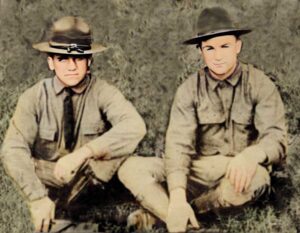
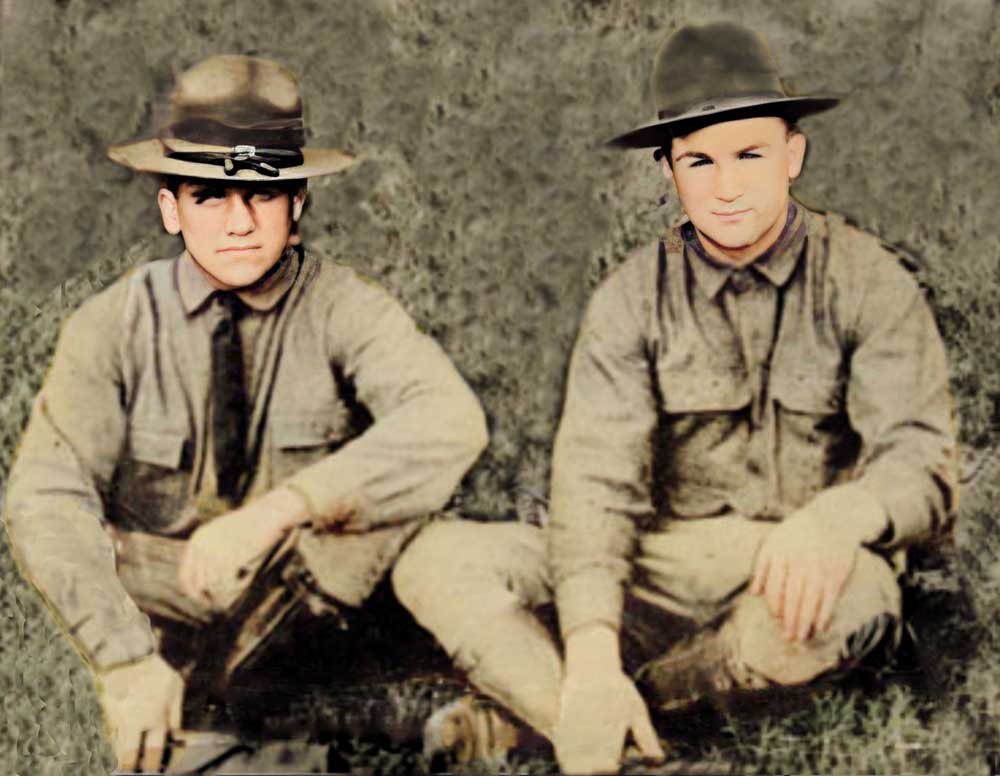
Mike and Tommy Gibbons, Chief Boxing Instructors U.S. Army – Camp Gordon, Georgia – 1918, WWI Gibbons FFG Archive
Over the next six-months, through aggressive propaganda and mandatory enlistment efforts, President Wilson drafted an army of 4-million men. Converting those men into battle-ready warriors was left, in large part, to a cadre of the era’s top boxers, including Benny Leonard, Johnny Kilbane, Johnny Coulon, Willie Ritchie, Leo Houck, Jeff Smith, Packey McFarland, as well as Mike and Tommy Gibbons.
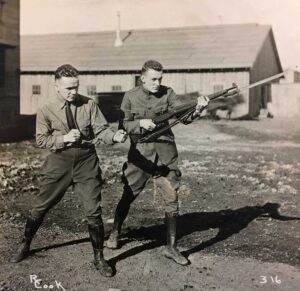
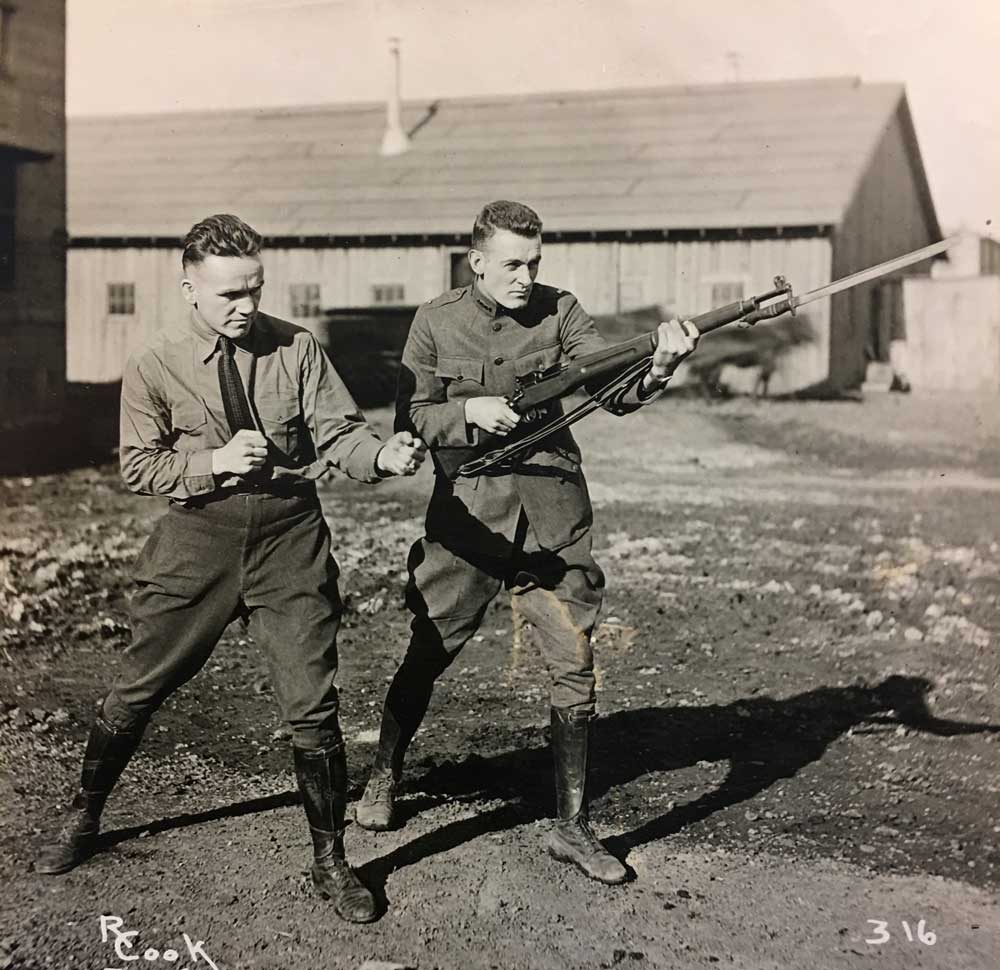
“Bayonetting is boxing with a blade.” Mike Gibbons, Chief Boxing / Hand Combat Instructor U.S. Army – Camp Dodge, Iowa – 1917 Gibbons FFG Archive
It was, by most accounts, Mike Gibbons, the St. Paul Phantom, who was quick to identify the similarities between boxing techniques and bayonet usage, that gave American soldiers the upper hand in trench warfare. During wartime, crowed esteemed New YorkWorld sportswriter Robert Edgren, “(Mike) will not fight to destroy just one man, but all of the darkness that threatens our great nation.”
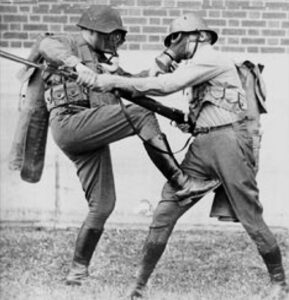
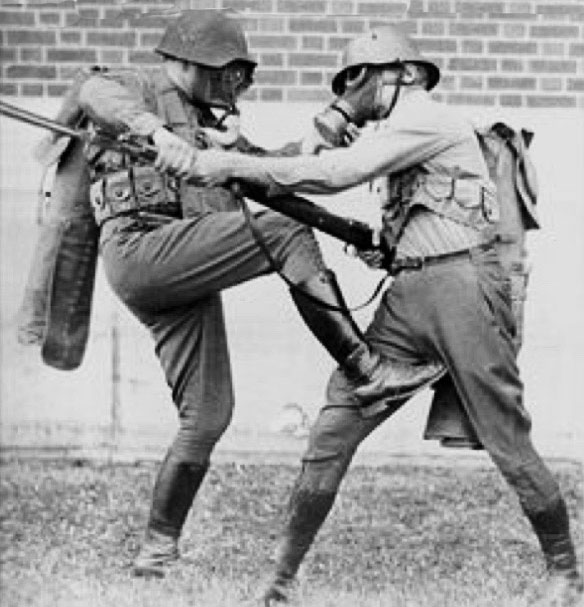
Mike and Tommy Gibbons wearing gas-masks instruct unarmed combat against a bayonet wielding foe. U.S. Army, Camp Meade, Maryland – 1918, WWI Gibbons FFG Archive
Mike, with his brother Tommy’s help, composed a game-changing guidebook on hand-to-hand combat, which was quickly adopted by the War Department – now known as the Department of Defense – (and is still used by the Armed Forces today). He was then appointed Chief Boxing Instructor at Camp Dodge in Johnston, Iowa, tasked with “imparting the finer points of the manly art to every soldier passing through.”
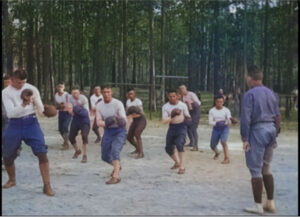
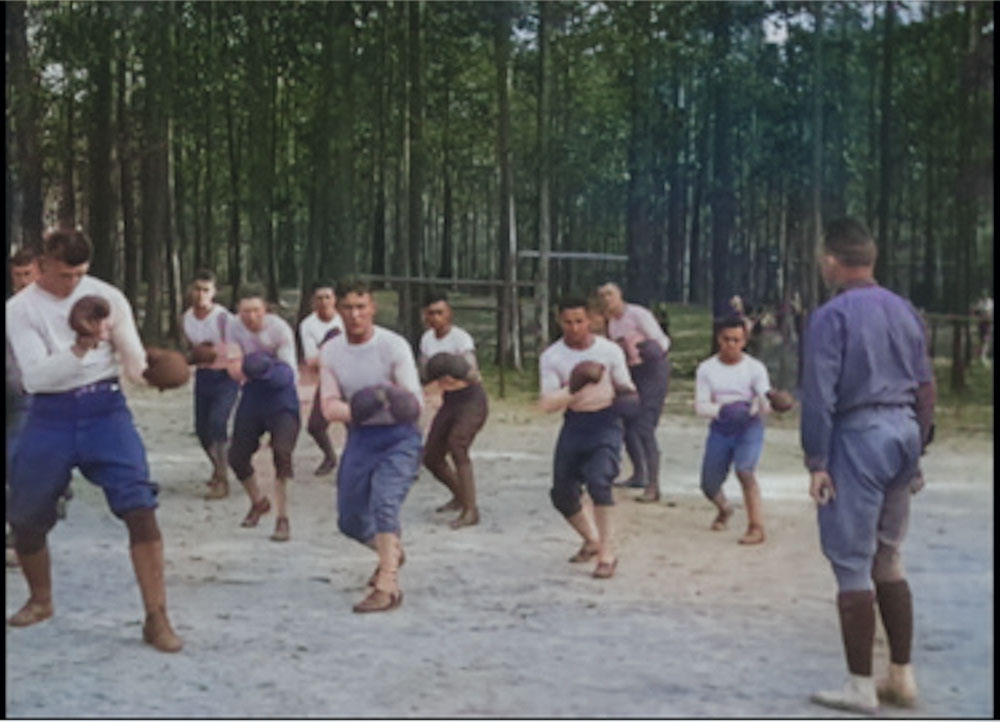
Mike Gibbons Instructs Boxing U.S. Army, Camp Gordon – Augusta, GA – 1918 Library of Congress
Mike Gibbons, teaming with Tommy, personally trained the Army’s fleet of Boxing Instructors and, in the end, they played a vital role in teaching the fight game to millions of young American soldiers. Boxing was so instrumental in preparing the troops for trench conflict that it was credited by American Expeditionary Forces Commander, General John J. “Black Jack” Pershing, and Secretary of War, Newton D. Baker, as a major reason the United States and its allies won the war. The motto “Train As You Fight, Fight As You Train,” derives from pugilism’s strategic role in The Great War.
One-hundred and five years later, February 24, 2022, the gods of war were once again stirred from slumber, with Russia savagely invading Ukraine, quickly killing thousands and displacing tens of millions of civilians. (As a century ago, the underdogs were vastly outnumbered, with 198,000 Ukrainian troops squaring off against nearly 1.5-million Russian soldiers).
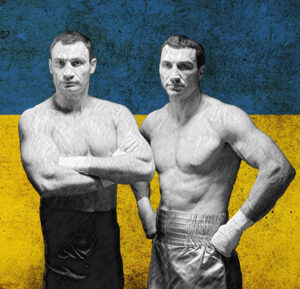
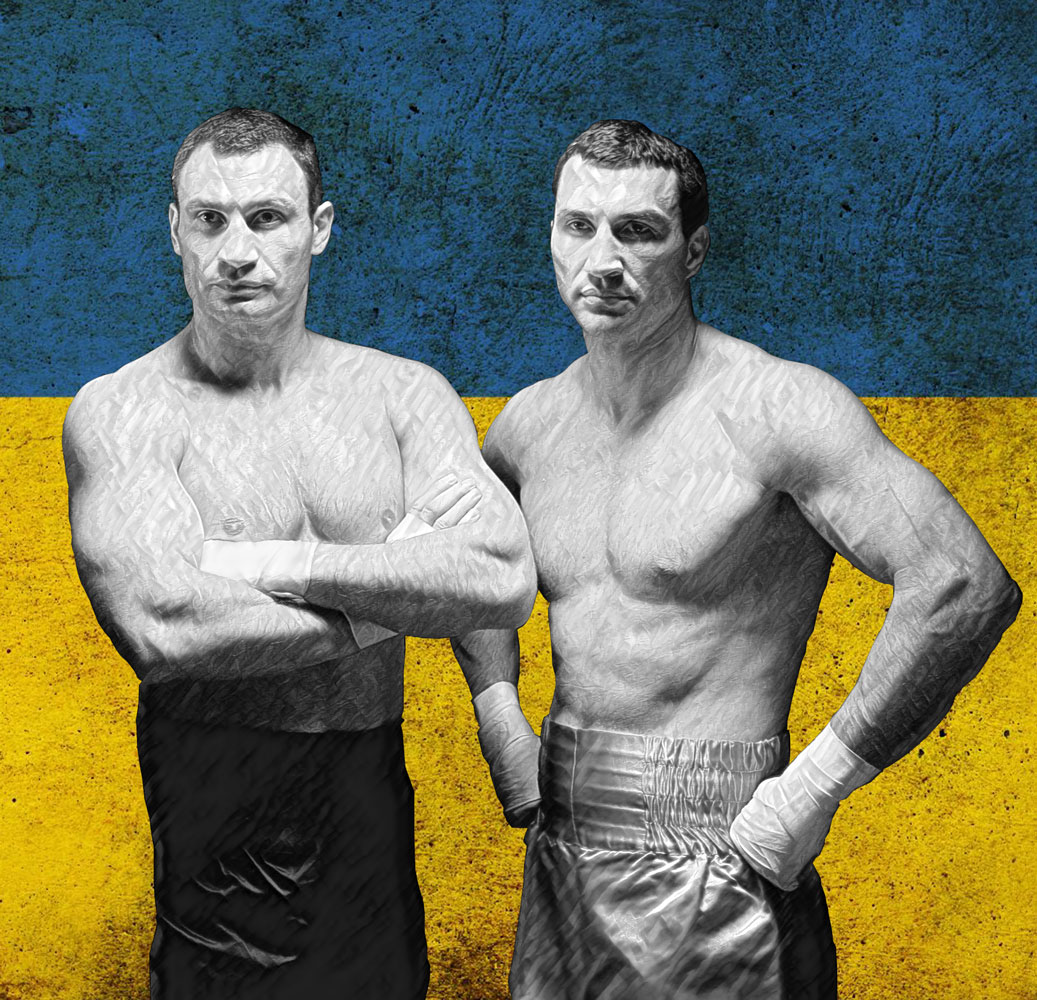
The Klitschko Brothers, Vitali and Wladimir, are two of the most accomplished boxers of the 21st century
But once more, warriors of the ring have again have stepped up to make game-changing contributions to the underdog’s good fight. In the early hours of the Russian invasion, a small, but powerful coterie of Ukrainian fist-slingers — led by retired heavyweight champion brothers Vitali and Wladimir Klitschko, and including Oleksandr Usyk and Vasiliy Lomachenko — raised their voices and laid down their lives in a show of courage and patriotism.
In an interview with ESPN, Wladimir said, “It is our duty as Ukrainian citizens to do everything in our power to support our country and our people during this difficult time.”
The Klitschko Brothers are two of the most accomplished boxers of the 21st century. Both brothers hold multiple world championships in the heavyweight division and have had successful careers in the ring. However, their accomplishments extend beyond their boxing careers, as they have also shown a courageous devotion to their home country of Ukraine during wartime.
“They’re in a fight unlike any they ever imagined,” writes Associated Press’ Tim Dahlberg. “The prize for this one isn’t a gaudy championship belt, but the survival of their country… They’re a formidable pair, ready to do whatever it takes to defend their country. So far that hasn’t included armed combat, but both have made it clear they will fight in the streets if it comes to that.”
Wladimir, the elder of the two brothers, began his professional career in 1996 and won his first world title in 2000. He went on to hold the WBO, IBF, and WBA titles multiple times, and is considered one of the top heavyweights of his era. He retired from boxing in 2017 with a record of 64-5.
Vitali, the younger brother, also had a successful career in the ring. He began his professional career in 1996 and won his first world title in 1999. He held the WBO and WBC titles multiple times and is considered one of the top heavyweights of his era. He retired from boxing in 2012 to focus on his political career, but returned to the ring in 2013 for one final ring battle.
Rather than run from Russia’s assault, the Klitschko Brothers have devoted unwavering support to Ukrainian President Volodymyr Zelenskyy throughout the year-long war.
“It’s really inspiring to see such famous people ready to protect our homeland with weapons in their hands,” Igor Nitsar, a Ukrainian sports reporter, told CNN last spring. “The Klitschkos had many chances to flee the country, but they stayed. I think it’s pure courage.”
Younger brother, Vitali, a mighty proponent of Western-style democracy, has served as mayor of Ukrainian capitol, Kiev, since 2014. For the last year, he has run the city from an underground bunker, while Ukrainian soldiers and brave citizens continue to stave off the Russian takeover. Wladimir, the older brother, has worked tirelessly by his brother’s side, serving as an ambassador for the Ukraine, lobbying for military and financial assistance from allied nations.
“Sometimes the graduates and denizens of our favorite bloodsport can inspire the world at large with their bravery outside of the ring,” Ring editor Doug Fischer wrote in a July 2022 editorial. “That’s what we’re witnessing with the bold stand (of the Klitschko Brothers) against Vladimir Putin’s tyranny.”
In an interview with BBC, Vitali said, “As a boxer, I have always fought for my country in the ring. Now, as a politician, I will continue to fight for my country, but in a different way.” The Ring’s Doug Fischer commented that the Klitschko Brothers are demonstrating the same “character and courage, duty and honor, and commitment to values and social justice” that boxing legends Joe Louis and Muhammad Ali embodied during their tumultuous hours of history.
“I get emotional when I think about it,” Tom Loeffler, who worked extensively with the Klitschko Brothers during their Hall of Fame ring careers, recently told The Ring. “Here’s two guys that could really live wherever in the world they want and pretty much do what they want because of the success they had in boxing and business (and they won’t abandon their country). They’re literally the highest-profile targets over there, after (Zelenskyy). It’s unimaginable. But they’re fighters to their core, as you can see by the courage they’re showing right now.”
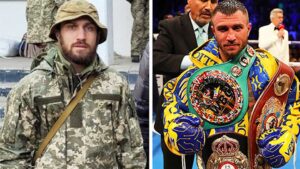
Ukrainian boxer Vasily Lomachenko joined defense force to stop the Russian invasion, Feb. 2022. (Images: Twitter/Getty Images)
Perhaps its just something that boxing heroes know in their blood and bones, that — as early 20th century French Prime Minister Georges Clemenceau once said — “war is too important to be left to the generals” and, as Martin Luther King, Jr. once conveyed, “If a man hasn’t discovered something that he will die for, he’s not fit to live.”
In that regard, the Klitschko Brothers — as Mike and Tommy Gibbons before them — know precisely who they are, and continue rising to history’s darkest challenges.
Contains information related to marketing campaigns of the user. These are shared with Google AdWords / Google Ads when the Google Ads and Google Analytics accounts are linked together.
90 days
__utma
ID used to identify users and sessions
2 years after last activity
__utmt
Used to monitor number of Google Analytics server requests
10 minutes
__utmb
Used to distinguish new sessions and visits. This cookie is set when the GA.js javascript library is loaded and there is no existing __utmb cookie. The cookie is updated every time data is sent to the Google Analytics server.
30 minutes after last activity
__utmc
Used only with old Urchin versions of Google Analytics and not with GA.js. Was used to distinguish between new sessions and visits at the end of a session.
End of session (browser)
__utmz
Contains information about the traffic source or campaign that directed user to the website. The cookie is set when the GA.js javascript is loaded and updated when data is sent to the Google Anaytics server
6 months after last activity
__utmv
Contains custom information set by the web developer via the _setCustomVar method in Google Analytics. This cookie is updated every time new data is sent to the Google Analytics server.
2 years after last activity
__utmx
Used to determine whether a user is included in an A / B or Multivariate test.
18 months
_ga
ID used to identify users
2 years
_gali
Used by Google Analytics to determine which links on a page are being clicked
30 seconds
_ga_
ID used to identify users
2 years
_gid
ID used to identify users for 24 hours after last activity
24 hours
_gat
Used to monitor number of Google Analytics server requests when using Google Tag Manager