


There they stand before The Garden now — the hall of halls, the work of art, “the temple of boxing,” they call it. The place you fight when you’ve finally made it. It’s New York City, Monday afternoon, July 1, 1912.
In a few hours, Mike Gibbons, the fiercely scientific Irish-American — the St. Paul Phantom, they call him — will fight for the first time inside The Garden. A grudge match against Sid Burns, a bellicose Brit with a crackerjack left and perpetual sneer. To prevent brawling inside the hallowed hall, Irish fans and English fans are seated on different sides of the arena. It promises to be a rager.

Madison Square Garden, July 1, 1912
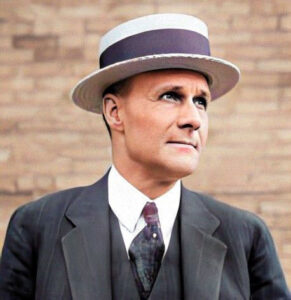
Mike, briskly marching toward The Garden’s entryway, snagged at the elbow by his pal, New York World sportswriter Robert Edgren, a towering fedora-crowned Dane.
“Before you go inside, Gibbons, look up,” Edgren says, pointing the way. “All the way up.”
Mike’s eyes, following the lines of The Garden’s majestic tower, architect Stanford White’s miracle, then higher still to the very top, above even the penthouse.
“First night at The Garden, Gibbons. It’s a big night for you,” Edgren says. “Just thought you should know: every man who’s ever fought inside this building says a prayer to this girl as they walk through the door. If you give a damn for tradition, Gibbons, they call her Diana.”

Anton Raphael Mengs, c. 1765
It’s Diana, the goddess of the hunt. At Madison Square Garden, in The Golden Age anyway, Diana is known as the patron saint of pugilism Every boxer who fights there, prays to her on the way in.
Like every fighter, Diana has a story — and it’s a story that resonates and deepens in surprising ways throughout the FIGHT FOR GLORY Universe. Diana’s story goes like this:
She is a goddess, the Roman figurehead of both hunting and moonlight. With bow and arrow, she is an immaculate shot and is praised for such. But she is also tasked with riding her chariot each night into the skies to light the moon. Because Diana’s nocturnal duty is so critical, she is made in her youth to swear she will never fall in love, marry, or procreate. If she were to do any of those things, then who would light the darkness?
Of course, she falls in love.
Impossible to resist the great and powerful Orion, one of the truly great warriors, a good man and a powerful one. Diana tries not to love him. She knows her duties and aims always to execute them perfectly. But everything in her body, her soul, her womb, they pull Diana to Orion. Until one night, wrapped in Orion’s embrace, Diana fails to light the moon.

Diana’s brother, the fierce warrior Apollo, knows the darkness is because Diana has failed her vow and fallen in love.
What’s more, he knows, the world would soon vanish if Diana did not return to her duties and light the darkness. Her lover, Apollo schemes, must be eliminated, removing all temptation from his sister’s divine path.
One afternoon, Apollo challenges his sister to an archery duel. For hours, they shoot perfectly at objects further and further away. Finally, Apollo lays down an ultimate challenge — hitting a tiny, quickly moving target in the water at least a mile away. This target, Apollo knows, is Diana’s lover, Orion, enjoying his ritual sunset swim.
Unawares, Diana sets, pulls, releases. More than a mile away, the arrow lands perfectly – and devastatingly – through the heart of Orion. He is killed instantly.
in both Northern and Southern Hemispheres
When Orion’s body washes to share that night, Diana realizes the tragedy of what’s occurred. Wracked with grief, she lifts his body into her chariot and drives deep into the darkening sky, screaming toward the place where night is most black. It is there that Diana lays her beloved Orion to rest, his body, belt, and sword transformed to starlight.
No longer will she have to endure a night without his light. And now, her light is ours.
Madison Square Garden
Spring 1920, and it’s the kind of year where Madison Square Garden, boxing’s big city cathedral, is scheduled for demolition. Its owners, a life insurance company, figures a high-rise office building is a smarter long-term bet than Ringling’s circus and gloved-sports.
Boxing’s King of Promoters Tex Rickard, with a pair of recent blockbuster fights under his belt, won’t stand for it. Ruling The Garden’s been his dream for twenty years now. And not only a little bit because of the Goddess Diana. He will not see her fall, and makes The Garden’s owners an offer they cannot refuse — a 10-year lease at a jaw-dropping $300,000 a year.
In this way, Rickard keeps them both from the wrecking ball: the sport of boxing’s sanctuary and the girl — the goddess, the huntress, Orion’s paramour, Diana, saved from slipping into the limbo of lost things.
Tex Rickard had changed a lot of things in the world, but the Goddess Diana would be the only thing he could ever save.

majestic tower – June, 1925
Summer 1925, and impresario Tex Rickard can no longer hold onto The Garden. The owners are dead-set this time: tear it down and start again.
June 8, just three days after the shocking powerhouse showdown between Tommy Gibbons and Gene Tunney, the Goddess will fall. The wrecking ball, barely restrained.
On this fateful afternoon, reports the New York Herald-Tribune, Diana, “she who had held poised vigil above New York’s city traffic for more than thirty years,” would “bow to mere man and the force of dynamos at work, and quit the sky to come to earth again.”
At 2:30 pm, sharp, “acetylene torches on the skeletonized tip of Madison Square Garden’s tower flared against the sky, and then went out,” observes the Herald-Tribune.
“Workmen shouted and waved their arms. The goddess would not dart in a swooping downward flight, nor mount a cloud toward Olympus, but at the command of electric wrenches and unpoetical men she would come to earth, swaddled in burlap robes and obeying the laws of fulcrums, levers, and machinery.”
As the bronze goddess descended slowly, caught about the torso with ropes which rose to a tripod derrick on the Garden’s tower platform, she was agile and comely, eulogizes the Herald-Tribune. “The arms, whose hands grasped her trademark bow, were lithe. Her head revealed exquisite features, a mouth full-lipped and graceful, a contemplative brow and calm eyes, her hair caught off her ears in a tiny Psyche knot strangely reminiscent of the present ‘boyish bob.’
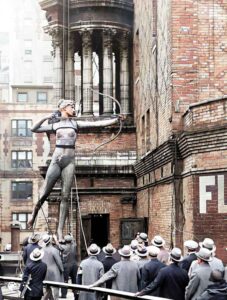
Then Diana turned once more in the summer breeze. With consummate grace, she moved. Her arrow pointed north, then northwest, then west. Her progress ground-ward was attended by a throng of mortal witnesses. There were many men who had never seen a goddess come to earth before.”
Photographers dodge about like crickets on the tarred roof of the Garden, while VIP guests loiter on the decayed wooden running track that circles it. Tex Rickard is, of course, one of them. They call this Garden “the house that Tex built, and the home of Tex’s Rangers or rather, the hockey team he founded, the New York Rangers.” Soon, it will all be gone.
“With her light and delicate outline silhouetted against the sky, Diana swung slowly earthward from the top of the tower. Not even the slings and ropes of wreckers could detract from her beauty,” writes the New York Times. “‘I had no idea how lovely she was,” architect Cass Gilbert tells the newspaper. “There is something almost wistful about her eyes!”
Indeed, Diana, in thirty years, had lived to see the tide of her times ebb away beneath her feet, and, finally, she is brought to repose on a pile of pine planking.
“With her, passed the soul of the old Garden,” the Herald-Tribune mourns. “What passes here today is not a building, not a statue, but a state of mind. There will be no more Garden forever.”

Sculptor (American, born Ireland), 1848–1907
Great Stair Hall, Philadelphia Museum of Art